
Why Social Policy Fails at the Last Mile: Referral Integrity and High-Risk Pregnancy Care in India
By Pali Pranjal · 20 May 2026
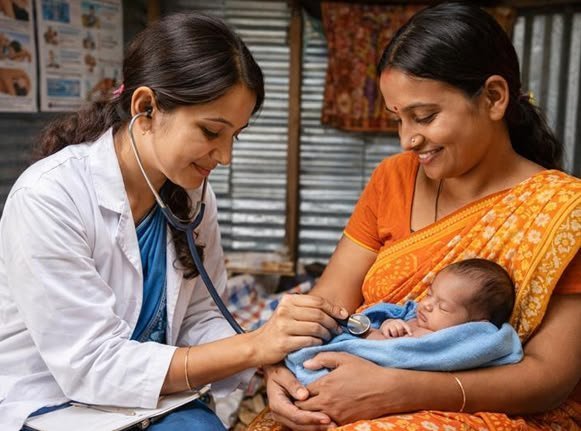
India has made significant progress in increasing institutional delivery rates, yet maternal mortality remains unacceptably high. This paper examines why reaching a hospital is often not enough.
Roughly 19,000 preventable maternal deaths occur in India each year despite real policy successes - a delivery failure, not a design failure. India's maternal health policy architecture has three layers: cash transfers (Janani Suraksha Yojana), universal entitlements (Janani Shishu Suraksha Karyakram), and risk screening (Pradhan Mantri Surakshit Matritva Abhiyan). The core problem is a fracture in "last-mile" delivery: high-risk pregnancies get correctly identified, but fail to reach timely emergency care because of broken referral networks - the "third delay" in the classic Three Delays Model of maternal mortality. Structural drivers include a roughly 80% specialist deficit in rural Community Health Centres, no closed-loop digital communication between referral levels, and supply-chain breakdowns that force families into out-of-pocket spending during emergencies. Drawing on Street-Level Bureaucracy theory, the paper argues that frontline health workers cope defensively under these constraints, effectively displacing systemic failure onto patients as learning, psychological, and compliance costs. The recommended path forward includes digital referral platforms, upskilling generalist staff for emergency obstetric situations, and decentralized contingency funding - the paper's central argument is that maternal survival depends on operational referral integrity, not just infrastructure or cash incentives alone.