From the Red Fort to the World: Thirteen Years of India’s Foreign Policy
By Sakshi Rathi · 12 Oct 2026
India’s foreign policy has evolved from diplomatic expansion to a more complex pursuit of strategic autonomy. This op-ed examines whether India can sustain its global ambitions amid shifting geopolitical alliances and domestic political uncertainty.
Can India Sustain Its Global Ambitions in an Increasingly Uncertain World?
India’s foreign policy under the current administration has evolved from expanding diplomatic outreach to pursuing a more prominent role in an increasingly complex international order. The article examines how strategic autonomy has remained central to India's foreign policy while its practical expression has shifted towards flexible partnerships, economic ambition and engagement with multiple centres of global power.
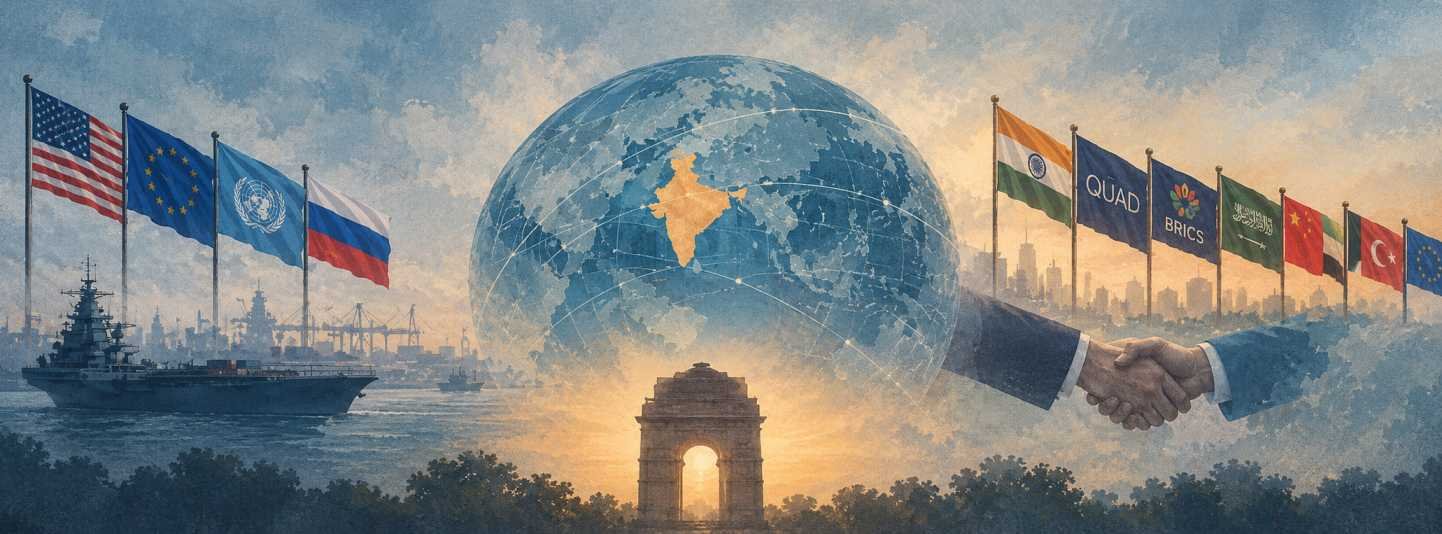
The article explores India's expanding relationships with the United States, Russia, the QUAD, BRICS and countries across the Gulf, Europe and the Indo-Pacific. It argues that India's ability to maintain relationships across competing geopolitical blocs has been one of the defining features of its foreign policy. However, emerging security alignments, including the defence pact involving Pakistan, Saudi Arabia and Türkiye, illustrate how changing regional dynamics may constrain India's strategic flexibility.
The discussion then turns to India's neighbourhood, examining how political change in Bangladesh has exposed the vulnerabilities of bilateral relationships closely associated with individual political leaders. The article highlights the importance of institutional relationships and enduring shared interests in ensuring that diplomatic gains survive changes in political leadership.
A central argument of the piece is that India's foreign policy has become increasingly intertwined with domestic politics. International partnerships, defence preparedness, technological development, energy security and India's growing role in the Global South are presented not only as diplomatic achievements but also as evidence of national transformation. Against this backdrop, youth mobilisation, unemployment, institutional accountability and a more contested domestic political environment raise questions about the sustainability of the political narrative surrounding India's global rise.
Finally, the article argues that the next phase of India's foreign policy will be defined less by the expansion of diplomatic reach alone and more by its ability to preserve existing gains amid geopolitical uncertainty and domestic political change. India's challenge is to translate strategic flexibility into resilient global influence, supported by domestic stability, economic performance and institutional credibility.
Explore how India's diplomatic achievements, shifting regional alliances and domestic political realities will shape its place in the world. Read the full piece.
Disclaimer: The views and opinions expressed in this piece are solely those of the author and do not necessarily represent the views or position of The Research Wise (TRW).