
Beyond Replacement: Is India Entering a New Demographic Regime?
By Dr. Pankaj Kumar Patel · 01 Aug 2026
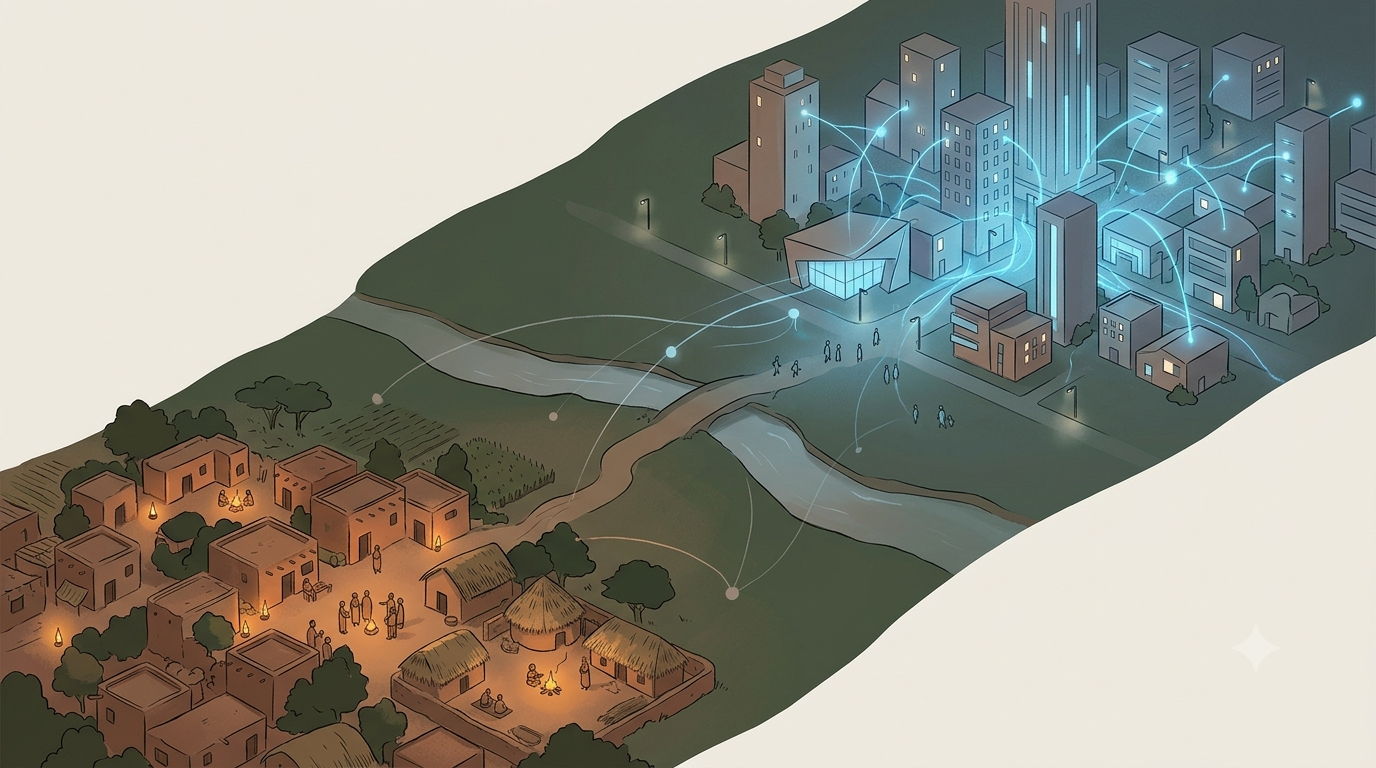
India's latest health and family survey shows the national fertility rate holding steady at two children per woman, a figure that seems to signal stability, but actually conceals a much bigger story. Beneath that flat national number, the country is splitting into different demographic worlds: cities have already dropped into low-fertility territory, while parts of rural and northern India remain well above replacement level. This piece argues that classical demographic transition theory, built around the idea that education, contraception, and rising incomes drive fertility down, no longer fully explains what's happening. Instead, it proposes a new lens: a "Networked Fertility Transition," in which reproductive choices spread not through geography but through digital connectivity, migration, and shared aspirations, letting a small town look demographically like a metropolis. The result is a India facing not one demographic challenge, but two simultaneous ones, growth in some regions, ageing and shrinking families in others.
The release of the National Family Health Survey (NFHS-6, 2023-24) has reignited public discussion on fertility trends in India. Much of the debate has focused on a single statistic: India's Total Fertility Rate (TFR) remains unchanged at 2.0 children per woman, the same level reported in NFHS-5 (2019-21). At first glance, the stability of the national figure appears unremarkable. Yet a closer examination of the data suggests that the most important demographic story is not the stability of India's fertility rate, but the profound transformations unfolding beneath the national average.
The NFHS-6 results reveal a country progressively characterized by demographic diversity. While fertility is above replacement level in parts of northern and central India, urban India has moved decisively into a low-fertility regime. National urban fertility now stands at 1.6 children per woman compared with 2.1 in rural areas. Moreover, the number of states and union territories recording below-replacement fertility has expanded considerably since NFHS-5. These patterns raise a fundamental question:
Is India merely completing its demographic transition, or is it entering an entirely new demographic regime?
For decades, demographic discourse in India was dominated by concerns over rapid population growth. Family planning programmes, reproductive health initiatives, improvements in female education, and declining infant mortality collectively contributed to one of the fastest fertility transitions observed in the developing world. The classical demographic transition model provided a useful framework for understanding these changes. As mortality declined and socio-economic conditions improved, fertility followed a predictable downward trajectory.
However, NFHS-6 suggests the explanatory power of this traditional framework may be weakening. Several determinants historically associated with fertility decline continue to improve. Female educational attainment has increased, age at marriage has risen, contraceptive awareness is widespread, and women's participation in decision-making has expanded. Yet the national fertility rate has remained unchanged. This apparent disconnect invites a reconsideration of the factors shaping reproductive behaviour in contemporary India.
The urban-rural fertility gap is now among the most significant demographic divides in the country. The distinction between high and low-fertility populations is not geographical but socio-economic and spatial. Urban residents across diverse states show remarkably similar reproductive behaviour despite differences in language, culture, and regional history.
This observation points towards a deeper transformation. Contemporary fertility decisions are no longer shaped exclusively by education, contraception, or economic necessity. They are increasingly influenced by aspirations, lifestyle preferences, housing costs, labour market uncertainty, migration, and changing expectations regarding parenthood. Digital connectivity has accelerated the diffusion of these values across both rural and urban populations. Young adults in small towns today are exposed to many of the same cultural influences as their counterparts in metropolitan centres. Fertility behaviour is therefore becoming embedded within broader processes of social change rather than merely demographic transition.
In this context, it may be vital to think beyond conventional demographic transition theory. India appears to be entering what may be termed a Networked Fertility Transition. Unlike the classical transition driven primarily by mortality decline and socio-economic development, this new phase is shaped by the diffusion of aspirations, lifestyles, and reproductive norms through increasingly interconnected social networks. Fertility preferences are transmitted not only through families and communities but also through digital media, migration networks, educational institutions, and urban exposure.
Under this framework, fertility decline does not proceed uniformly across regions. Instead, it spreads through social and informational connectivity. Individuals increasingly compare themselves with reference groups that extend far beyond their immediate locality. The desired family size becomes linked to aspirations for education, mobility, consumption, and quality of life. Children are viewed less as economic contributors and more as intensive investments requiring substantial financial and emotional resources. Consequently, reproductive decisions become increasingly sensitive to perceived opportunity costs.
This perspective may help explain several features of the NFHS-6 findings. It accounts for the persistence of low fertility across culturally diverse urban populations. It explains why fertility decline continues even in areas where traditional demographic determinants have already reached advanced levels. Most importantly, it suggests that future fertility trajectories may depend as much on social and cultural transformations as on conventional family planning interventions.
The policy implications are profound. India is no longer confronting a single demographic challenge. In states where fertility remains relatively high, investments in female education, reproductive health services, and women's empowerment remain essential. Simultaneously, many urban areas must begin preparing for the long-term consequences of sustained low fertility, including population ageing, shrinking family networks, changing patterns of elder care, and future labour force constraints.
This does not imply that India faces an imminent demographic crisis. Unlike several East Asian societies, marriage remains nearly universal, family ties remain strong, and childlessness remains relatively uncommon. Nevertheless, the foundations of family formation are changing. The large sibling networks that characterised previous generations are gradually giving way to smaller family structures. The social consequences of this transition will unfold over the coming decades.
The central lesson of NFHS-6 is therefore not that India's fertility has stopped falling. Rather, it is that fertility has ceased to be a uniform national phenomenon. The demographic future of India will increasingly be shaped by the interaction of urbanisation, digital connectivity, changing aspirations, and evolving family norms. Understanding this emerging reality requires moving beyond simplistic narratives of population control or replacement-level fertility.
India's fertility transition is not ending. It is entering a new phase. The challenge for researchers, policymakers, and society is to recognise that the questions of the future are no longer about how many children Indians have, but about how changing social realities are reshaping the very meaning of family, reproduction, and demographic change in twenty-first-century India.
Email: pankajpatel.iips@gmail.com