
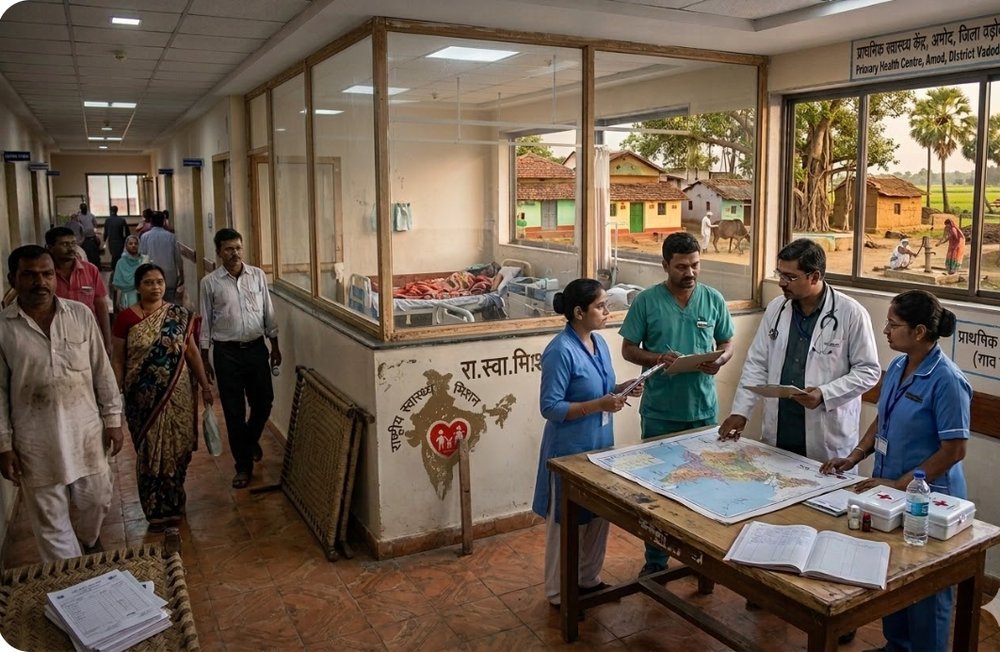
The Pulse of Care
Mapping India's Healthcare Human Capital Beyond the Headline Workforce Numbers
India's healthcare capacity is often discussed through aggregate numbers: medical colleges, doctors, nurses, hospitals and health facilities. But national totals can conceal one of the most important determinants of healthcare access—where health workers are located, what skills they possess, where they work, and whether the workforce is aligned with population health needs.
The Pulse of Care examines India's healthcare human capital through this broader lens. The project evaluates professional density, geographical distribution, workforce composition and emerging requirements of India's frontline health system, mapping current capacity against the country's expanding health and universal health coverage objectives.
India has expanded its health workforce substantially over the past decade. According to WHO, the number of medical colleges increased from 387 in 2014 to 731 in 2024, while medical seats increased from 51,348 to 112,112. Nursing education has also expanded significantly, and more than 120,000 Community Health Officers have been developed as part of the expansion of comprehensive primary healthcare through Ayushman Arogya Mandirs.
However, increasing supply does not automatically produce equitable access.
One of the persistent challenges is geographical maldistribution. WHO analysis of India's health workforce found that although rural India accounted for approximately 68% of the population in 2018, only around 36% of health workers were located in rural areas. The rural share was approximately 31% for doctors and 38% for nurses and midwives.
This imbalance has direct implications for health-system performance. A district may have an adequate national-level workforce ratio while still experiencing shortages in particular specialties, occupations or locations. Similarly, the presence of a health facility does not necessarily mean that it has the personnel required to provide the services it is expected to deliver.
The project therefore treats healthcare human capital as a distribution and capability problem, not merely a counting exercise.
The analysis considers multiple dimensions of the workforce: professional density, rural–urban distribution, public–private employment, cadre composition, skill mix, gender, geographic concentration and the relationship between workforce availability and population need. Where possible, these dimensions are examined at subnational levels to identify patterns that national averages obscure.
The project is particularly interested in the frontline workforce because primary healthcare depends on more than physicians. Nurses, midwives, community health officers, pharmacists, laboratory personnel, allied health professionals, community health workers and other cadres collectively determine whether preventive, promotive, diagnostic and basic treatment services reach communities.
This is increasingly important as India's health needs change. An ageing population, rising non-communicable diseases, continuing maternal and child health priorities, mental-health needs and the increasing complexity of chronic disease management require a workforce capable of providing continuity of care rather than episodic treatment.
Workforce planning must therefore consider not only how many workers India needs, but also which workers, with which competencies, in which locations, for which populations.
Retention is another critical component. WHO's evidence on rural and remote health workforce highlights that recruitment alone is insufficient when working conditions, career progression, infrastructure, professional support and personal circumstances make long-term retention difficult.
The Pulse of Care consequently views workforce policy through a health-labour-market perspective. Training capacity, employment opportunities, migration, remuneration, deployment, retention and professional development are interconnected. A mismatch at any point can create shortages even when aggregate workforce numbers appear adequate.
The project's broader contribution is to shift the discussion from "How many healthcare professionals does India have?" to "Does India have the right healthcare workforce, in the right places, with the right skills, to meet emerging population needs?"
The evidence generated can support workforce planning, state-level health strategies, primary-care strengthening, training investments and more targeted approaches to addressing geographical and professional inequalities.
Primary objective: To map India's healthcare human capital across density, distribution, composition and capability dimensions and identify the workforce gaps most relevant to equitable, accessible and future-ready healthcare delivery.