
Census 2027: Challenges and Opportunities for India's Data Systems
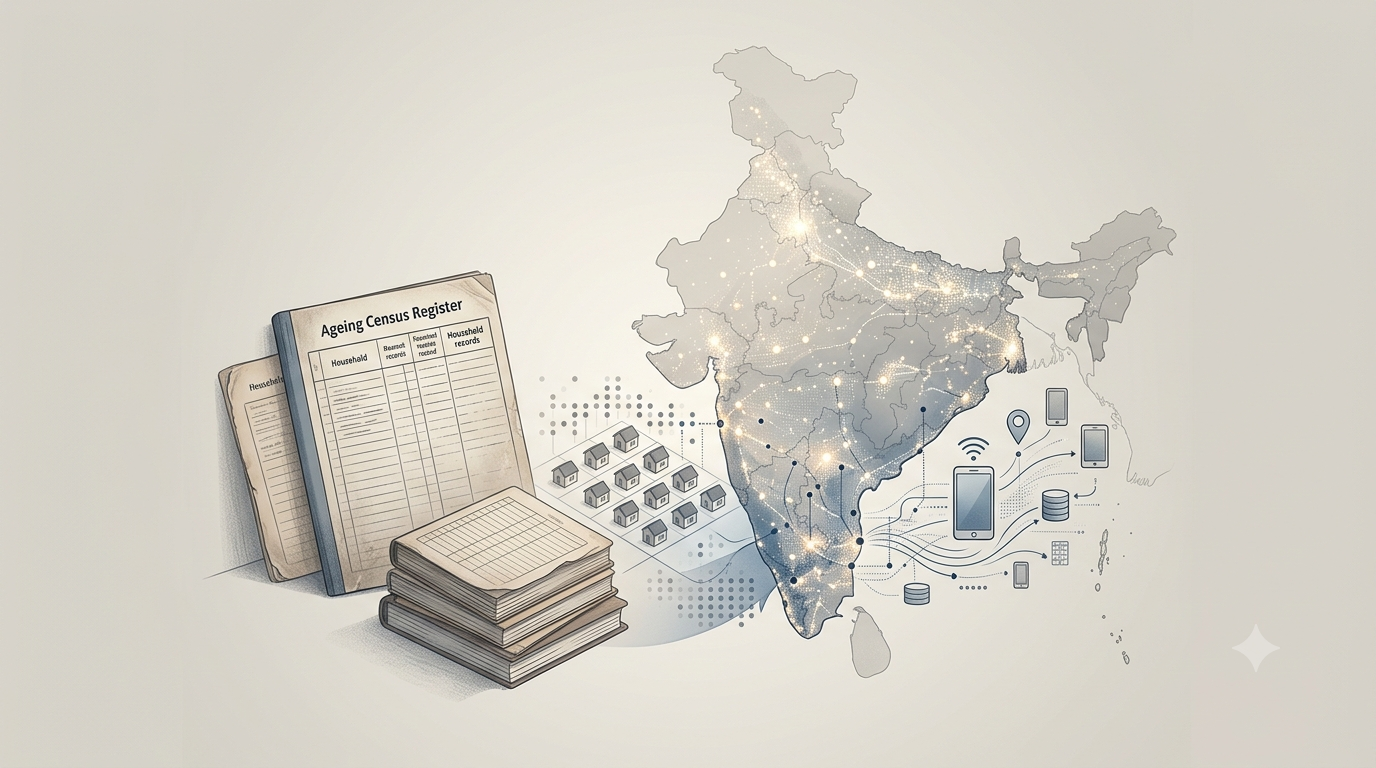
India's decennial Census is among the most significant data collection exercises undertaken by any government in the world - a comprehensive enumeration of over a billion people that provides the foundational data underpinning everything from parliamentary constituency delimitation to poverty programme targeting, from school construction planning to tuberculosis case detection. The 2021 Census, scheduled to begin in April 2020, was postponed due to the COVID-19 pandemic. It was not conducted in 2021. It was not conducted in 2022, 2023, 2024, or 2025. As of mid-2026, no confirmed date for commencement has been announced, through 2027 is the earliest credible timeline based on operational planning requirements. India is now living through the longest Census data gap in its post-independence history - a gap with concrete, measurable consequences for the quality of development planning, welfare delivery, and democratic representation. What We Are Missing The 2011 Census data that currently underpins most of India's official population estimates, welfare targeting, and infrastructure planning is now 15 years old. India's population has grown by approximately 200 million people since 2011. Urban populations have expanded dramatically, with dozens of cities crossing population thresholds that trigger different infrastructure, governance, and welfare classifications. Literacy rates have changed. Household sizes have contracted. Migration patterns have shifted fundamentally. The socioeconomic topography of India's 640,000 villages and 8,000 towns has been transformed by a decade and a half of economic change. None of this change is visible in the official data infrastructure that planners and policymakers use by default. The consequences include welfare programme undercounting - populations that have moved through rural-urban migration or natural growth in underserved areas may fall outside programme coverage anchored to 2011 demographic realities. Infrastructure misallocation follows, since school construction, hospital placement, road prioritisation, and water supply planning all use population projections derived from 2011 baselines, so facilities get built where populations were, rather than where they are. Constituency delimitation is also affected: the upcoming delimitation of parliamentary constituencies is constitutionally tied to Census data, and without a completed Census, delimitation cannot proceed on defensible empirical grounds. Finally, research and programme evaluation gaps emerge as researchers relying on Census sampling frames and denominators work with degraded inputs, producing results whose benchmarks may be significantly wrong. The Interim Landscape: What Data Exists The data vacuum left by the Census delay has been partially, imperfectly, and inconsistently filled by several data sources. NFHS-5 (2019-21), the fifth round of the National Family Health Survey, is the most comprehensive nationally representative dataset currently available with post-2011 data, though it is designed for health-sector analysis and cannot substitute for Census data in planning exercises requiring full population counts. The Periodic Labour Force Survey (PLFS), conducted annually since 2017-18, provides current labour market data but has a much smaller sample and narrower scope. The Civil Registration System and Sample Registration System (SRS) provide estimates of birth rates, death rates, and infant and maternal mortality through a dual-record system covering approximately 8,000 sample units, though sample sizes limit district-level reliability. Aadhaar and administrative databases now cover over 1.3 billion residents and, in principle, contain a near-complete enumeration of India's resident population, but Aadhaar data is not publicly available for research or planning purposes and its coverage of the very young, the very poor, and undocumented migrants is imperfect. What Needs to Happen for Census 2027 A successful Census 2027 exercise - if it is to restore India's data infrastructure to the standard required for evidence-based planning - will require several things beyond simply recommencing an interrupted enumeration. Digital enumeration infrastructure should make 2027 a digital-first exercise, with mobile-based enumeration replacing paper schedules, GPS-tagged household mapping, and real-time quality checks. An enhanced migration module is needed, since conventional Census migration questions are insufficiently granular for tracking the circular, seasonal, and multi-directional migration patterns that characterise contemporary Indian internal migration. Faster data release timelines are essential - the 2011 Census's detailed tables were not available until 2016-18, and a 2027 Census must commit to publishing primary results within 12-18 months of enumeration completion. And linkage with administrative data offers an opportunity to develop a statistical linkage framework with Aadhaar, the Civil Registration System, and other administrative databases. The Urgency Cannot Be Overstated Five years of Census delay has not been a neutral administrative inconvenience. It has degraded the quality of welfare delivery, infrastructure planning, health programme targeting, and democratic representation. The longer it continues, the more compounded these errors become. Census 2027 must be treated as a national priority - adequately funded, politically insulated from further postponement, and designed for the India of 2027 rather than the enumeration methodologies of 2011. The Research Wise will continue to contribute analysis on Census-related data and policy questions as the 2027 exercise takes shape. To discuss Census data gaps and their implications for your programme or research: info@theresearchwise.com
Get our research and event invitations
Subscribe for new publications, workshops, and policy commentary from The Research Wise.

How Social Media Shaped Gen Z’s Self-Identity Online and Affects Their Mental Health
Social media usage is growing rapidly, reshaping the fabric of the online world and coinciding with a mounting...
Read More →
BRICS 2026: Beyond the Aggregates
The expanded 10-member BRICS bloc presents massive collective numbers. But analyzing the individual economies...
Read More →