Census 2027: Challenges & Opportunities for India's Data Systems
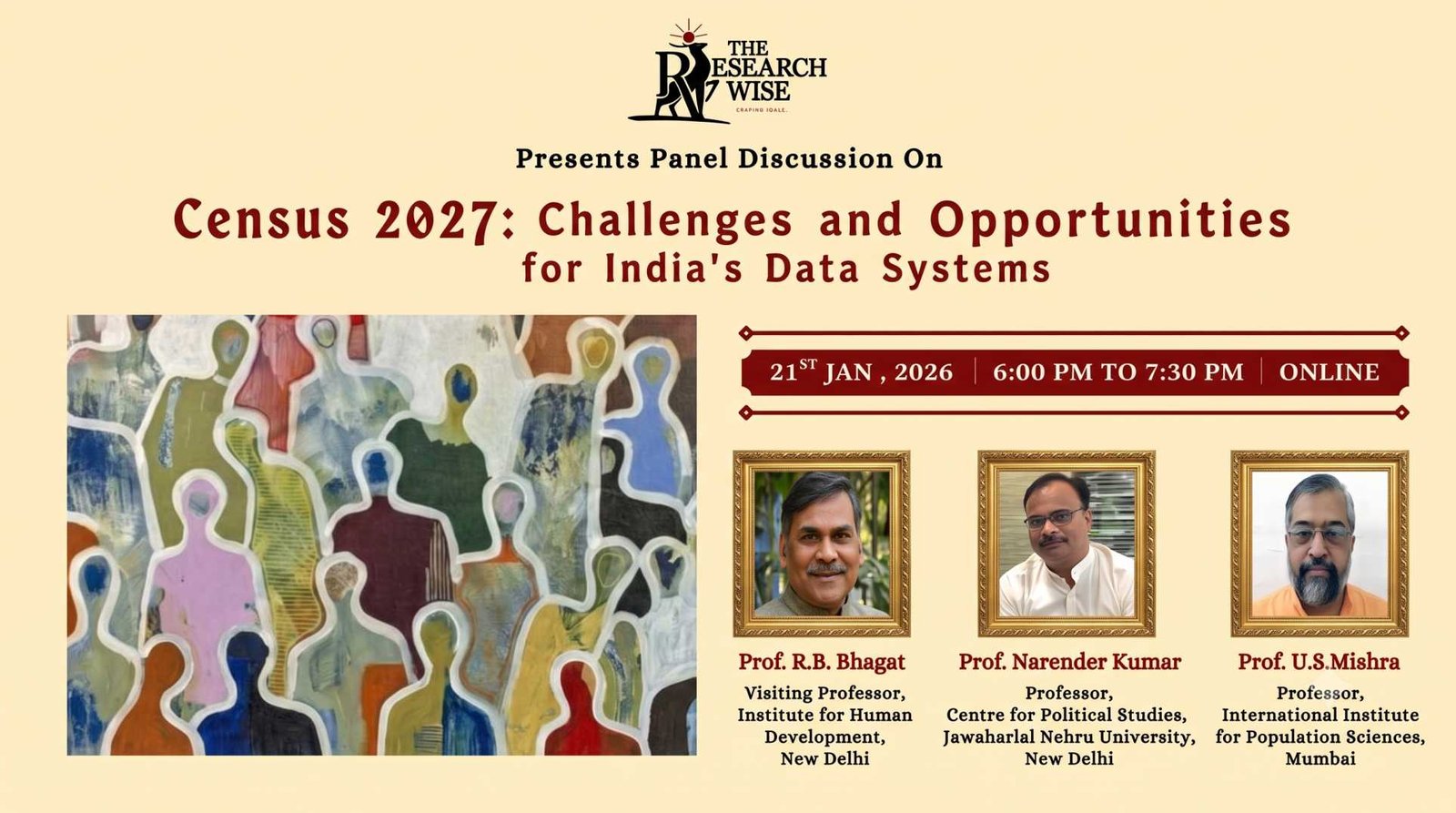
The Research Wise hosted a flagship national online panel discussion focused on "Census 2027: Challenges and Opportunities for India's Data Systems," featuring distinguished experts including Prof. R.B. Bhagat (Visiting Professor at IHD New Delhi), Prof. Narender Kumar (Chairperson and Professor at the Centre for Political Studies, JNU), Prof. Udaya S. Mishra (Professor at IIPS Mumbai), and Prof. Syeed Unisa (Advisor at TRW and Retired Professor at IIPS Mumbai). The panel delivered an exhaustive analysis of the upcoming 16th Census of India and its far-reaching consequences for public policy, socio-economic research, and national governance. These lead experts across demography, political science, and development studies convened to address the structural shifts occurring within India's statistical infrastructure, offering a detailed critique of the unprecedented fifteen-year gap since the last complete census in 2011. The panel thoroughly explored the conceptualization of Census 2027 as facing "3D challenges" (Delayed, Digitalised, and Diluted), while dissecting the operational realities of shifting from traditional paper surveys to self-enumeration and mobile applications. Beyond technological transitions, the conversation tackled highly sensitive policy imperatives, including the methodological pre-coding required for accurate caste enumeration, the risk of worsening the digital divide in rural communities, data privacy protections, and the high-stakes political debate surrounding parliamentary constituency delimitation and federal equity under the national vision of Viksit Bharat.
The event achieved exceptional engagement and nationwide visibility under the moderation of Mr. Pankaj Kumar Patel, drawing over 400 registered attendees and sustaining a live audience of more than 250 participants spanning top-tier academic institutions, think tanks, and policy organizations across the country. The audience reflected a diverse cross-section of India's intellectual community, with PhD scholars and university students comprising nearly 60% of the turnout alongside significant representation from senior academic faculty, industry consultants, and policy analysts from leading centers like IIPS Mumbai, JNU New Delhi, TISS, and the Institute of Human Development. Following the structured interventions by Prof. Bhagat, Prof. Kumar, Prof. Mishra, and Prof. Unisa, the webinar transitioned into an energetic, extended open forum. During this session, participants raised critical questions regarding the visibility of seasonal and circular migrant workers in data collection, strategies for rebuilding public trust among enumerators in the field, and the necessity of establishing independent institutional oversight to guarantee data security and prevent partisan manipulation. The session ultimately closed with widespread acclaim as a vital, high-impact platform for advancing data literacy and scientific temperament among India's emerging scholars